Key Takeaways
- Not all garage floor coatings perform the same. Paint, stains, sealers, epoxy, polyurea, and polyaspartic systems behave very differently once hot tires, vehicle traffic, moisture, and daily wear enter the picture.
- How a coating cures matters more than the label on the can. One-part, air-drying products struggle with durability, while two-part systems like epoxy, polyurea, and polyaspartic coatings form stronger bonds with concrete and hold up better over time.
- Long-lasting garage floors rely on systems, not shortcuts. Proper surface preparation, a bonded base coat, and a protective topcoat work together to protect a concrete garage floor from chemicals, moisture, and real-world use.
Walk into any home improvement store and you’ll see shelves full of paint cans, epoxy kits, sealers, and products all claiming to be the right answer for your garage floor. That’s where a lot of confusion starts. Many homeowners hear the phrase garage floor coating and assume everything on those shelves performs at the same level. It doesn’t.
The reality is that there are very different types of garage floor coatings, and they behave in very different ways once they’re exposed to hot tires, vehicle traffic, moisture coming up through the concrete, and daily wear. Some options are quick cosmetic fixes. Others are built as true floor coating systems meant to protect a concrete garage floor for years.
This guide breaks down the most common garage floor finishes, explains how they interact with a concrete surface, and helps you sort out which options make sense based on durability, cost, and real-world performance.
What Counts as a Garage Floor Coating (And What Doesn’t)
A garage floor coating is any material applied directly to a concrete floor with the goal of protecting it, improving appearance, or both. That sounds simple, but the category covers a wide range of products.
Some options, like garage floor paint or acrylic floor paint, sit on the surface as a thin film. Others, like epoxy floor coatings, polyurea coatings, and polyaspartic systems, chemically bond to the concrete surface. Sealers and stains fall somewhere in between, offering limited protection or color without much build.
Thickness, bonding method, surface preparation, and how the coating cures all play a bigger role than brand names. Existing flooring, damaged concrete, and minor cracks also change how well any coating will perform.
One-Part vs Two-Part Garage Floor Coatings
One of the easiest ways to sort through floor coatings is to understand how they cure.
One-part coatings harden by air drying. These are commonly found at home improvement stores and are often marketed as a low cost or cost effective option. Because they dry rather than chemically cure, they tend to form a thinner film with lower chemical resistance and less grip on the concrete garage floor.
Two-part coatings cure through a chemical reaction that starts when the materials are mixed together. This category includes true epoxy coating systems, polyurea coatings, and polyaspartic topcoats. The chemical reaction creates a denser surface that bonds more aggressively to the concrete and holds up better under heavy use.
If a floor paint hardens simply because the air touched it, it usually won’t handle hot tires, heavy loads, or high traffic areas the way a two-part system will.
The List of Coating Types
Garage Floor Paint (Latex or Acrylic Concrete Paint)
Garage floor paint is often the first option many homeowners consider. It’s inexpensive, easy to find, and simple to apply with basic tools.
Paint works by coating the surface of the concrete floor with a thin layer of color. It doesn’t soak in deeply or form a strong mechanical bond. That’s why garage floor paint tends to struggle once cars start coming in and out.
Common issues include peeling, flaking, and hot tire pickup, where heat and pressure from tires cause the paint to lift. Moisture in the concrete, temperature changes, and humidity levels inside the garage all speed up this process.
Paint can make sense as a short-term cosmetic fix or in a space with very light use. For garages that see daily vehicle traffic, it rarely holds up for long.
Concrete Stains (Acid Stain & Water-Based Stain)
Concrete stains work differently than coatings. Instead of sitting on top of the floor, stains add color by reacting with or soaking into the concrete surface.
Stains add color and character, and they won’t peel the way paint does. The tradeoff is protection. Stains don’t create a protective layer that shields the floor from chemicals, moisture, or abrasion.
In a working garage, stains don’t solve durability problems. They’re better suited to decorative spaces or areas where appearance matters more than resistance to wear.
Concrete Sealers (Penetrating vs Topical)
Concrete sealers are designed to reduce dust, make cleaning easier, and slow down moisture movement through the concrete floor.
Penetrating sealers soak into the concrete and help protect from moisture without changing the look much. Topical sealers form a light film on the surface.
Sealers can be helpful in low-use garages or as a temporary solution, but they don’t replace a true garage floor coating system.
Epoxy Garage Floor Coatings
Epoxy garage floor coating systems are one of the most commonly searched garage floor finishes, and for good reason. When installed correctly, epoxy floor coatings offer better durability than paint or sealers and can dramatically change how a garage looks and cleans.
Epoxy coatings bond to the concrete surface through a two-part chemical reaction. The quality of surface prep and the thickness of the epoxy floor play a major role in how well the coating performs.
DIY Epoxy Kits (Big Box Store Epoxy)
DIY epoxy kits are widely available and marketed as an affordable option. These products usually apply in a thin layer and rely on minimal prep work.
While they can look good at first, many struggle with hot tire pickup, peeling, and yellowing over time. Moisture in the concrete and limited surface preparation often cause early failure.
Professional-Grade Epoxy Coatings
Professional epoxy floor coatings use higher-quality materials, more thorough surface prep, and thicker application. These systems offer improved durability, stronger adhesion, and more consistent results.
That said, epoxy can still be brittle compared to newer coating technologies. In garages with wide temperature swings or moisture issues, epoxy may not be the longest-lasting option.
Polyurea Garage Floor Coatings
Polyurea coatings are a step up in performance. These systems bond aggressively to the concrete surface and offer superior flexibility compared to traditional epoxy.
That flexibility matters because concrete expands and contracts with temperature changes and humidity levels. Polyurea coatings move with the slab instead of fighting against it, which helps protect the garage floor over time.
Polyurea also provides excellent chemical resistance, making it a strong choice for garages exposed to oil, road salt, and automotive fluids. It handles heavy loads, hot tires, and high traffic areas with less risk of failure.
Polyaspartic Garage Floor Coatings
Polyaspartic coatings are closely related to polyurea chemistry and are often used as a high-performance top layer.
These coatings cure quickly, allowing a faster installation process and a shorter return-to-service window. Polyaspartic topcoats offer strong stain resistance, high gloss options, and better UV stability for garages with sun exposure.
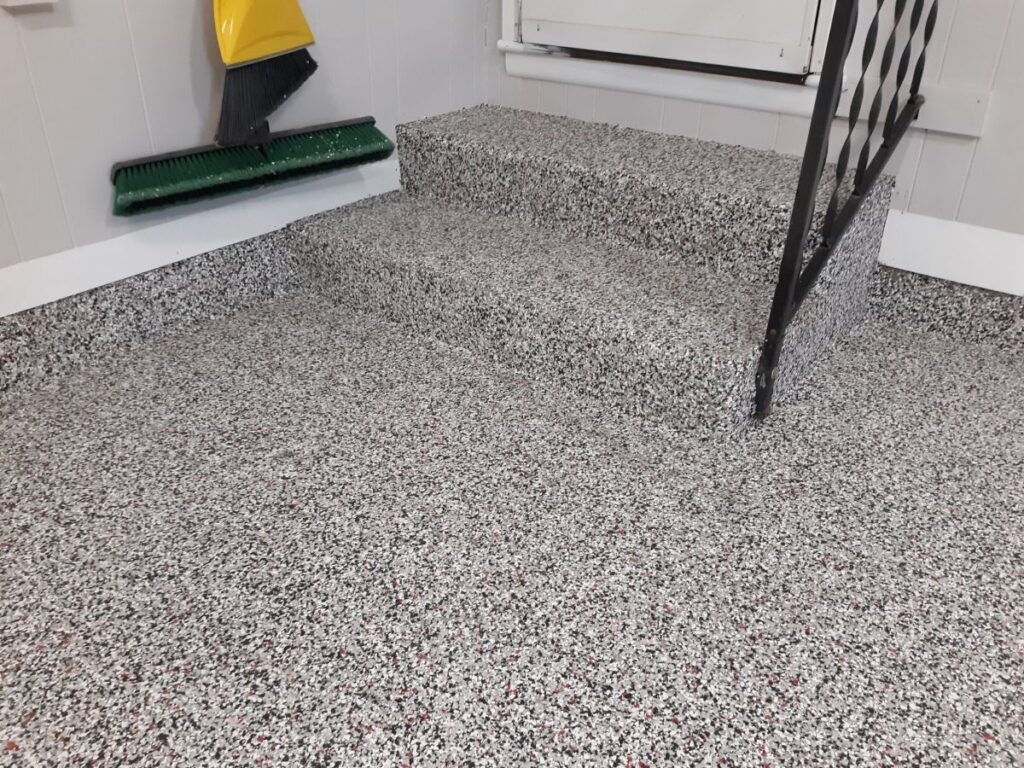
In many systems, a polyurea base coat paired with a polyaspartic topcoat creates a durable, long-lasting garage floor finish. (In fact, that’s what we do!)
Concrete Overlays and Resurfacing Systems
Concrete overlays and resurfacing products are used when a floor has extensive repairs, uneven areas, or damaged concrete that can’t be coated as-is.
A concrete resurfacer creates a new surface, but it still needs a protective coating on top. Overlays add cost and time, so they’re usually reserved for floors that can’t be saved with prep work alone.
Interlocking Garage Floor Tiles (Not a Coating, But an Alternative)
Garage floor tiles and interlocking floor tiles are often compared to coatings because they change the look of a space quickly.
Tiles and garage floor mats install fast and require little prep. The downside is moisture can get trapped underneath, cleaning can be harder, and performance under heavy use varies. For homeowners deciding between tiles and floor coatings, the difference comes down to protection versus convenience.
How Moisture in Concrete Affects Garage Floor Coatings
Moisture is always present in concrete. It moves up through the slab as vapor, and that movement can cause coatings to fail if the system isn’t compatible.
Paint, acrylics, and thin epoxy coatings often can’t handle moisture vapor transmission. This leads to bubbling, peeling, and damaged concrete. Moisture testing before professional installation helps match the right floor coating to the conditions of the garage.
Why Flexibility Matters in Garage Floor Coatings
Concrete shifts with temperature changes. Coatings that are too rigid crack or lose their bond.
Flexible coatings, like polyurea systems, move with the slab. That flexibility improves durability and helps protect the concrete surface year after year.
Cure Time vs “Ready to Use” Time
A garage floor can look dry long before it’s ready for real use.
Hot tires expose under-cured coatings quickly. Faster-curing systems reduce this risk and shorten downtime, which matters for many homeowners.
What Is Hot Tire Pickup And Why It Ruins Garage Floors
Hot tire pickup happens when heat and pressure from tires soften a coating and cause it to lift from the floor.
Thin films, floor paint, and lower-quality epoxy coating systems are the most vulnerable. Stronger chemical bonds and thicker systems resist this issue far better.
Why the Best Garage Floors Use a Coating System, Not a Single Product
Long-lasting garage floors rely on systems, not single products.
A base coat bonds to the concrete, decorative flakes add texture and hide imperfections, and a protective topcoat seals everything in place. Each layer plays a role in protecting the garage floor from heavy foot traffic, vehicle traffic, dirt, dust, and chemicals.
Our Recommendation for Lasting Garage Floors
For homeowners who want a garage floor that holds up to real use, system-based solutions perform best.
Professional polyurea coatings paired with polyaspartic topcoats offer strong adhesion, chemical resistance, and durability across a wide range of conditions. With proper surface preparation and installation, these systems protect concrete floors without constant touch-ups.
If you’ve been searching for garage floor coating near me or garage floor coatings near you and want a solution built for long-term performance, a professional evaluation can help clarify what makes sense for your space.
Choosing a Garage Floor Coating That Actually Holds Up
There’s no single product that fits every garage. Understanding how different coatings work makes it easier to avoid costly mistakes.
If you’re looking for a floor coating that protects your garage, cleans easily, and holds up under daily use, professional systems are worth a closer look. A conversation with an experienced installer can help you decide what fits your garage floor and how you use the space – give us a call for a free consultation and quote!